Polyglot · course
Learn Arabic
Read real Arabic from your first week
The course teaches Modern Standard Arabic (al-fuṣḥā) — the written standard shared by every Arab country, the language of books, newspapers, news broadcasts and formal speech, and close kin to the Classical Arabic of the Qur'an and the old poets, which it also reads. It is not a spoken dialect: at home, people speak Egyptian, Levantine, Gulf, Maghrebi and other varieties that differ from the standard and from each other, and most learners add one later. Standard Arabic is the one every reader of Arabic shares.
About 5–10 minutes per lesson
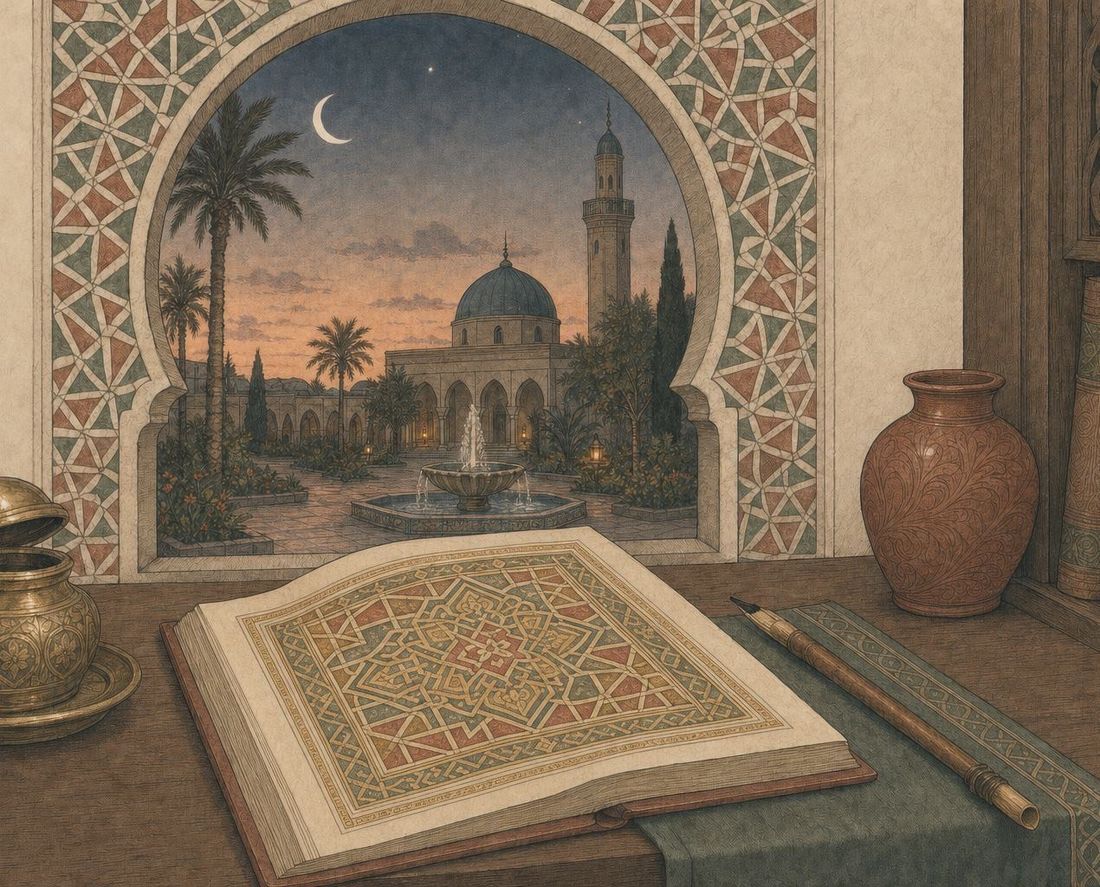
By the end of the course
The road leads to Arabic itself — the Qur'an, classical poetry, modern prose, the news — in the original.
Try it — the first check of Lesson 1
Quick check
ب, ت and ث share one shape. What tells them apart?
Arabic, from the alphabet to the Qur'an and al-Mutanabbī
Arabic is the written language of more than twenty countries, of the Qur'an, and of a literature that runs from pre-Islamic poetry to today's novels and news. This online course takes you from zero — including the alphabet — to reading real passages of that literature in the original.
It is built for beginners with no Arabic at all. After Unit 1 you can sound out any fully vowelled Arabic word; by Unit 6 you are reading the whole Fātiḥa, two verses of al-Mutanabbī, and Article 1 of the Universal Declaration of Human Rights with tap-glosses.
What the course covers
6 units · 18 lessons — progress saves in your browser.
Real texts, from the first unit
Every reading is a real, attributed passage, quoted exactly as standard editions print it — never invented app-sentences alone. By the final unit, the readings are the literature:
- The Qur'an, al-Fātiḥa— the Basmala in Unit 1, verses 2–4 in Unit 3, all seven verses in Unit 6
- al-Mutanabbī— “The horses, the night, and the desert know me” — the verse said to have cost him his life
- Gibran and Ḥāfiẓ Ibrāhīm— Gibran's “Give me the flute” and the Arabic language speaking of itself as the sea
- Proverbs and Kalīla wa-Dimna— six proverbs and sayings, and the lion and the hare, retold
- Universal Declaration of Human Rights— Article 1 in its official Arabic text — vowelled, then its first sentence as printed
How the course works
The method is graded reading: short lessons that teach one system at a time — the letters and their joined shapes, the vowel marks, the verbless sentence, the root-and-pattern system that builds Arabic words, the cases, the verb — and then put it to work immediately in real, attributed text. Quoted texts follow their standard sources: the Qur'an in the Ḥafs reading (simple modern spelling, the Tanzil text) and the Declaration in its official UN Arabic text; the one practice fable is retold after Kalīla wa-Dimna and labeled as such, and composed practice lines are marked as composed.
Everyday Arabic print leaves out the short vowels. The course prints every vowel so you can read aloud from the first lesson, and ends by showing you a sentence exactly as it is printed, without them. Every example word carries audio, every word in a reading can be tapped for its meaning and grammar, wrong answers explain why, and vocabulary returns for review on a spaced schedule.
Common questions
Is this Modern Standard Arabic or a dialect?+
Modern Standard Arabic — the shared written standard of the Arab world, used in books, newspapers, the news and formal speech. It is not what people speak at home: each region has its own spoken dialect, and learners who want conversation usually add one (Egyptian and Levantine have the most learning materials). Standard Arabic comes first because it is the Arabic that every reader shares and the key to the written literature.
Do I have to learn a new alphabet first?+
Yes. Unit 1 covers all 28 letters with their joined shapes, the vowel marks, the doubling mark, hamza, and the “sun letters” that change how the word for “the” is said — in three short lessons, anchored to Arabic words English already borrowed, like sugar, coffee, and algebra. After Unit 1 you can sound out any fully vowelled Arabic word.
Arabic is usually printed without vowels. Why does the course show them?+
So you can read aloud and hear the grammar from day one. Newspapers and most books leave out the short vowels and expect the reader to know the word; the Qur'an, poetry, children's books and dictionaries print them in full. The course prints every vowel, explains exactly what is left out in ordinary print, and in the last unit shows a sentence as it is really printed.
Can I use this course to read the Qur'an?+
It is a start. The Basmala comes in Unit 1 and the whole Fātiḥa by Unit 6, quoted in the Ḥafs reading in simple modern spelling (not the Uthmani script of printed copies), and the grammar you learn — the root system, the construct, the cases, pronouns and verbs — is the grammar of Qur'anic Arabic too. The course gives plain English renderings for reading along; it does not teach recitation rules (tajwīd).
Do Arabic speakers really pronounce the case endings?+
Partly. The case endings are real grammar and every vowelled text shows them, but everyone drops them at the end of a sentence or phrase, and in unscripted Standard Arabic most speakers drop most of them. News readers, preachers and Qur'an reciters pronounce them inside the sentence. The course teaches them for reading — they tell you who does what — and states plainly where speakers leave them out.
How long does the course take?+
The course is 6 units — 18 lessons of about 5–10 minutes each — a few hours of focused work plus spaced review. By the end you read the Fātiḥa, two verses of al-Mutanabbī and Article 1 of the Declaration of Human Rights with tap-glosses. Reading ordinary unvowelled Arabic comfortably takes months more; this course is the start.
Do I need an account?+
Unit 1 is open to everyone with no account at all — progress is saved in your browser. From Unit 2, a free account keeps your lessons, streak, and review deck saved to you across devices.
Also from Polytranslator: Arabic translator · Learn Ancient Greek · all courses