Polyglot · course
Learn Latin
Learn to read the Latin of Caesar, Virgil, and the Vulgate
The course teaches Classical Latin — the grammar of Caesar, Cicero, and Virgil, and the Latin of the standard textbooks — and its readings reach from the late Republic to the Vulgate Bible, whose grammar is essentially the same (plus one famous line of Descartes). Words are printed the way school editions and dictionaries print them: with long marks (ā, ē) added as a reading aid, and v for the consonant u. The lessons teach the classical pronunciation and set the church (ecclesiastical) pronunciation beside it; the audio uses an Italian-style voice close to church Latin.
About 5–10 minutes per lesson
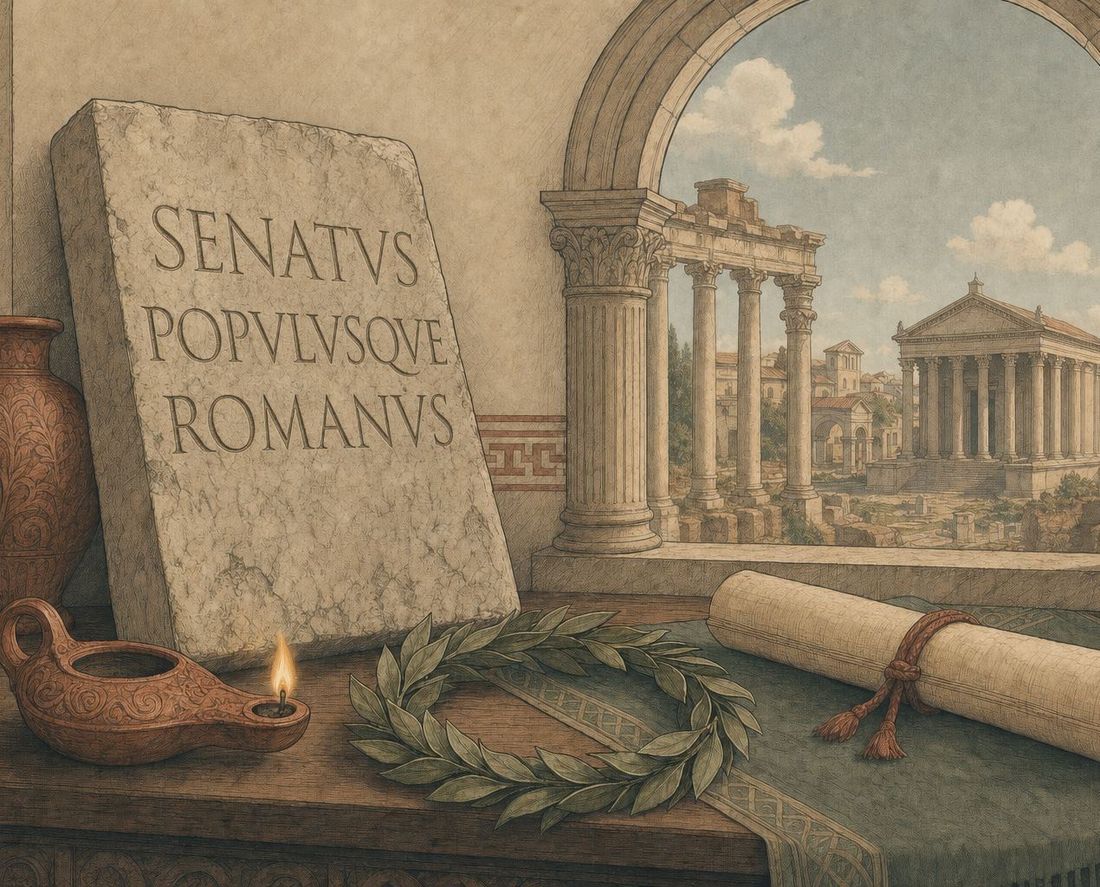
By the end of the course
Finish the course and you read Latin itself — Caesar, Virgil, Cicero, the Vulgate — in the original.
Try it — the first check of Lesson 1
Quick check
Which of these letters did the Romans NOT have?
Latin, from the alphabet to the Aeneid
Latin is the language of Caesar, Cicero, Virgil, and Ovid, of the Vulgate Bible and the medieval Church, and of European science well into the 1700s. This online course takes you from zero to reading real passages of that literature in the original.
It is built for beginners with no Latin and no grammar terms. The alphabet is the one you already use, so Unit 1 goes straight to what is new: long and short vowels, the stress rule, and how the Romans said their letters. Its first reading is three words long: Vēnī, vīdī, vīcī.
What the course covers
6 units · 18 lessons — progress saves in your browser.
Real texts, from the first unit
Every reading is a real, attributed passage, quoted exactly as standard editions print it — never invented app-sentences alone. By the final unit, the readings are the literature:
- Virgil, Aeneid— half its first line read aloud in Unit 1, the whole line parsed in Unit 5, and the first three lines read in Unit 6
- Caesar, The Gallic War— “Gallia est omnis dīvīsa in partēs trēs” — the opening sentence, first in part, then whole
- Catullus, poem 85— “Ōdī et amō” — both lines, complete
- Horace, Cicero, Ovid, Juvenal, Martial— carpe diem, Ō tempora, ō mōrēs!, “a drop hollows a stone”, a sound mind in a sound body, and Martial's epigram to Sabidius, complete
- The Vulgate— the opening of the Pater noster, John 1:1, Deus cāritās est, and Quō vādis?
How the course works
The method is graded reading: short lessons that teach one system at a time — vowel length and stress, gender, the case endings, the verb, the two past tenses — and then put it to work immediately in real, attributed text. Quoted passages follow the standard editions word for word, in the school-edition spelling this course teaches; the one practice fable is retold after Aesop and Phaedrus and labeled as such.
Every example word and reading line has audio, every word in a reading can be tapped for its meaning and grammar, wrong answers explain why, and vocabulary returns for review on a schedule that spaces out as you get it right.
Common questions
Is this Classical or Church Latin?+
The grammar and vocabulary are Classical Latin — the standard starting point, and the Latin of Caesar, Cicero, and Virgil. Church (ecclesiastical) Latin uses the same grammar, and the course reads the Vulgate from Unit 2 onward. The two traditions differ mainly in pronunciation: Unit 1 teaches the classical sounds and sets the church sounds beside them, and the course audio uses an Italian-style voice close to church Latin.
How was Latin pronounced?+
In Caesar's day c and g were always hard (Cicero was “Kikero”), v was a w (vīnum, “weenum”), ae sounded like “eye”, and long vowels were held about twice as long as short ones — long enough to tell mālum “apple” from malum “evil”. Church Latin, the Italian-based pronunciation of the Catholic Church and of choirs, softens c and g before e and i, says v as v, and turns ae into e. Unit 1 covers both, plus the stress rule that places the stress in any Latin word.
Why are there lines over some vowels?+
They are macrons, and they mark long vowels: ā is held longer than a. The Romans rarely marked vowel length at all; dictionaries and school editions add them because vowel length changes meaning and decides where the stress falls. This course prints every one, including in quoted passages, which the standard editions usually print without them.
How long does the course take?+
The course has 6 units — 18 lessons of about 5–10 minutes each — so the core is a few hours of focused work, plus spaced review. By the end you read the opening of the Aeneid, the first sentence of Caesar's Gallic War, and a complete epigram of Martial with tap-glosses. Reading Latin unassisted takes months more; this course gets you started honestly.
Do I need to know grammar terminology?+
No. Every term the course uses — case, gender, nominative, declension — is defined in plain words before it is used, and every word in every reading can be tapped for a full explanation.
Do I need an account?+
Unit 1 is open to everyone with no account at all — progress is saved in your browser. From Unit 2, a free account keeps your lessons, streak, and review deck saved to you across devices.
Also from Polytranslator: Latin translator · Learn Ancient Greek · all courses