Polyglot · course
Learn Shakespearean English
Learn to read the English of Shakespeare and the King James Bible
The course teaches the Early Modern English of Shakespeare's London, roughly 1590–1611 — the language of the plays, the sonnets, and the King James Bible — quoted as the standard modern editions print it (the Folger Shakespeare texts, in modernized spelling). In other words: exactly the English you meet on the page of any edition, and hear from any stage.
About 5–10 minutes per lesson
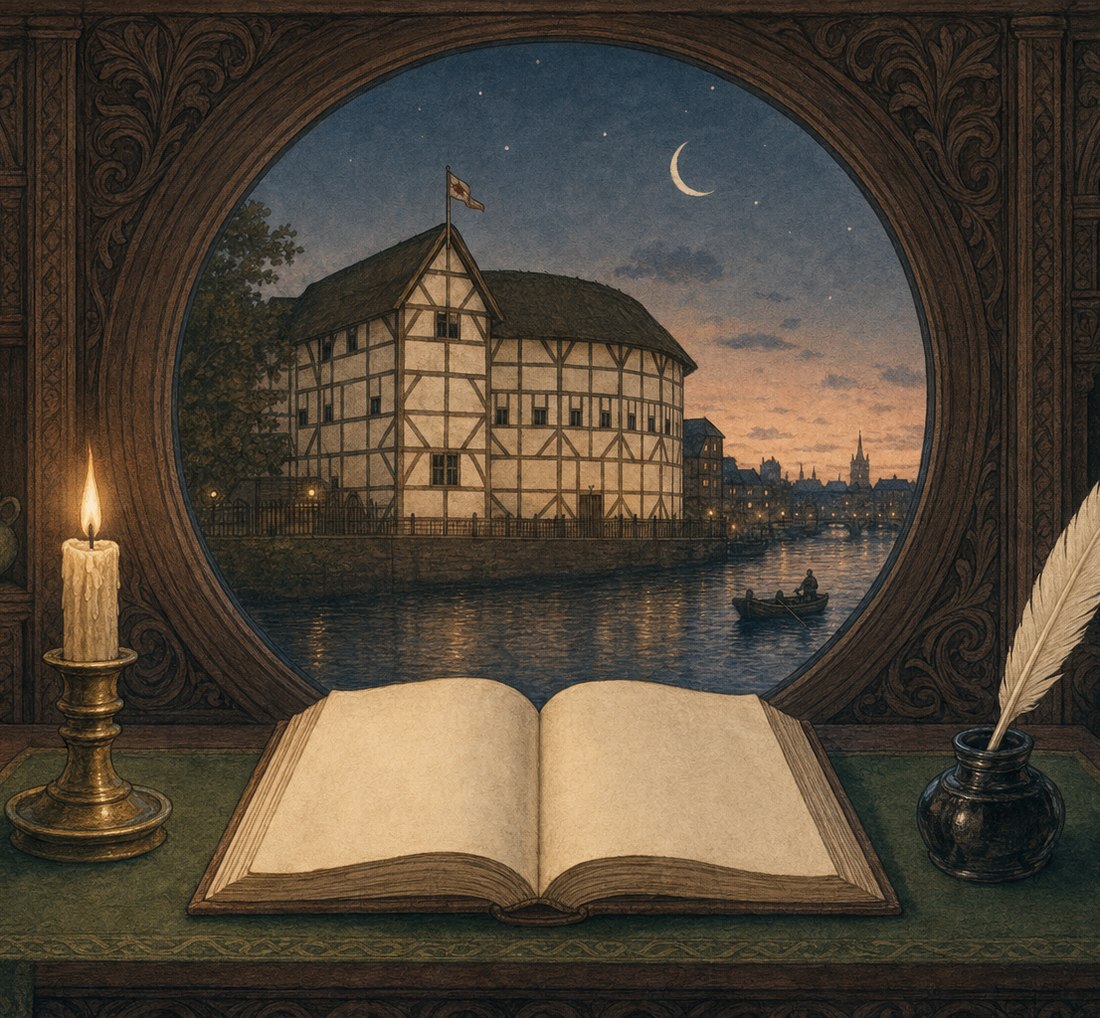
By the end of the course
Finish the course and you read Shakespeare's English itself — the sonnets, the soliloquies, the King James Bible — in the original.
Try it — the first check of Lesson 1
Quick check
A messenger says: 'I shall attend you presently.' When is he coming?
Want to start with the pronouns? Read our free lesson on thou, thee, thy, thine and ye, with examples and practice.
Shakespeare's English, read right
Shakespeare's English is Early Modern English — close enough to read, far enough to misread. Wherefore means why, not where; doubt means fear; want means lack; and thou follows social rules that carry half the drama of any scene. This online course teaches the four hundred years of drift between his English and yours, then reads the real speeches with you, whole.
It is built for readers, students, and actors: nothing to memorize by rote. Unit 1 starts with the words that look familiar and aren't — the first line it corrects is the most misquoted question in English.
What the course covers
6 units · 18 lessons — progress saves in your browser.
Real texts, from the first unit
Every reading is a real, attributed passage, quoted exactly as standard editions print it — never invented app-sentences alone. By the final unit, the readings are the literature:
- Sonnet 18— opened in Unit 1, scanned in Unit 4, finished — volta, couplet, and the false friend in line 10 — in Unit 5
- Hamlet— I know not “seems”, the readiness is all, and the full To be or not to be
- Romeo and Juliet— the balcony scene — where wherefore finally means what Juliet meant
- Macbeth and Julius Caesar— Tomorrow and tomorrow and tomorrow; Friends, Romans, countrymen — with interrèd explained at last
- The King James Bible— Psalm 23 in the 1611 text — where I shall not want means something better than you thought
How the course works
The method is graded reading: short lessons that teach one system at a time — the thou/you machinery, questions without do, the false friends, the ten-syllable meter — and then put it to work immediately in real, attributed text. Every quotation follows the Folger Shakespeare editions or the standard King James text, and the course states plainly which conventions (like the sounded -èd) are editorial.
Every reading can be tapped word-by-word for meaning and grammar, wrong answers explain why, and vocabulary returns for review on a spaced schedule. The whole course was checked line-by-line against the standard editions before publication.
Common questions
Isn't Shakespearean English just Old English?+
No — they are centuries apart. Old English (Beowulf, before ~1150) is effectively a foreign language with extra letters and a case system. Shakespeare wrote Early Modern English (~1500–1700): you can read every word, which is exactly why the misreadings sneak through. This course teaches the drift — the moved meanings, the lost pronoun, the meter — not a new alphabet. If you want the real foreign country, our Old English course is one click away.
If I can already read it, what is there to learn?+
Three systems. Vocabulary that moved: doubt meant fear, want meant lack, let meant hinder, presently meant right now — familiar words that silently break famous lines. Grammar that died: thou with its own verb forms and social rules, questions without do (knowest thou?), the subjunctive, the be-perfect (he is come). And the verse engine: iambic pentameter, the sounded -èd, and why 'tis exists. None of it is hard; all of it changes what the lines say.
How long does the course take?+
The foundations course is 6 units — 18 lessons of about 5–10 minutes each — a few hours of focused work plus spaced review. The last two units are real texts read whole: a complete sonnet arc, the great soliloquies, and scripture. Fluent reading of whole plays takes longer; this course is built to make every page of them honest going.
Do I need an account?+
Unit 1 is open to everyone with no account at all — progress is saved in your browser. From Unit 2, a free account keeps your lessons, streak, and review deck saved to you across devices.
Will I learn how Shakespeare's actors pronounced it?+
The course reads in modern pronunciation — the convention of classrooms, editions, and almost every stage. Original Pronunciation (the reconstructed 1600 sound, which restores some lost rhymes and puns) is real scholarship and noted where it matters, but it is not what you need to read or perform the texts today.
Do I need to know grammar terminology?+
No. Every term the course uses — subjunctive, auxiliary, iamb — is defined in plain words before it is used, and every word in every reading can be tapped for a full explanation.
Also from Polytranslator: Shakespearean English translator · Learn Old English · all courses